
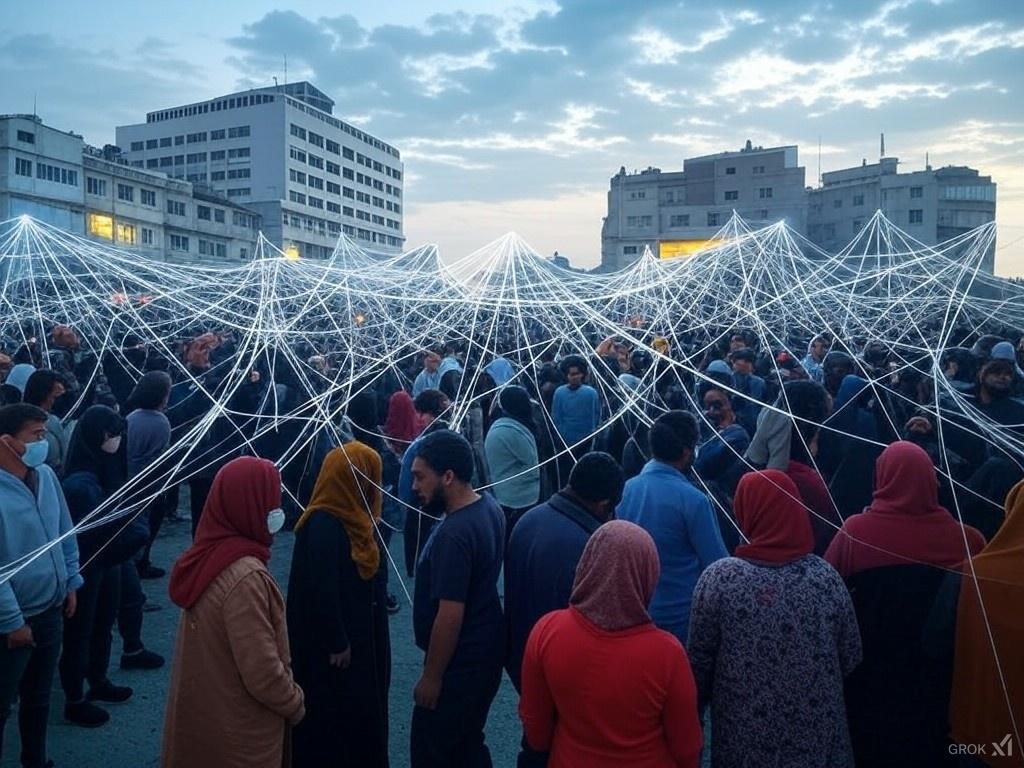
I have never been one to seek comfort in ideological bubbles. It’s not conflict I desire but resolution—a meeting point of thoughts where clarity prevails over confusion. The pursuit of that clarity is increasingly met with resistance, not from individuals but from the systems governing our lives. The question that lingers, unanswered, is: to what end? Recently, even platforms like X, which once heralded free speech, have begun to silence voices under the guise of curbing “negativity.” But who defines negativity? Is exposing wrongdoing considered negative simply because it disrupts the status quo? Investigating corruption or manipulation might be unpleasant, but censoring those efforts ensures the perpetuation of injustice. Ezekiel 33 tells us, “You are the trumpet.” If you witness danger, it is your duty to sound the alarm. Yet censorship strips away that responsibility, dulls our sense of self, and fractures the bonds that connect us.
If you cannot see the danger in this, it may be because the system already has you.
The Illusion of Difference
When you strip events of their surface-level distinctions and examine only the actions and decisions behind them, patterns emerge. These patterns reveal what is ordinary, what is possible, and what lies at the fringes—the outliers. For decades, the collection of such data has been conducted en masse, often through tools like Google Analytics. I watched as language subtly shifted narratives in news reports. Over time, words once viewed neutrally gained negative connotations, and those connotations spread rapidly through digital channels. This was not accidental. It was monitored, studied, and manipulated, and we allowed it to happen.
Recognizing these patterns can feel like predicting the future. People’s actions often mirror past behavior, driven by their conversations, aspirations, and the systems shaping their environment. Don’t be swayed by the rhetoric. Instead, observe. Learn their names. Trust the instincts that warn you of deception even when words appear benign.
I already have the answer, I am searching for the question.
I believe the answers already exist within me, but I struggle to articulate the right questions. Writing helps, as each character I create embodies a fragment of myself—a different lens through which I examine the world. I often play devil’s advocate, not to antagonize but to refine ideas through friction. This habit endears me to some and alienates others, but I can’t ignore the dissonance between the narratives we’re fed and the reality I sense.
Artificial intelligence introduces another layer to this exploration. It has the potential to either amplify manipulation or serve as a tool for uncovering hidden truths. I find myself drawn to questions about belief systems. Faith, ideology, and cultural narratives have long been targets of manipulation, not because they lack value but because controlling belief is the most effective form of control. I am crafting something—an evolving compilation of thoughts, characters, and experiences that reflect a broader truth.
This project transcends personal catharsis. I envision a community-driven effort that mirrors the structure of religious study, scientific inquiry, and open debate. The goal is to distill similarities across disciplines, to find the threads binding us rather than the walls dividing us. The information we seek is embedded within us, waiting for the right process to unlock and disseminate it.
Belief Outside The System
I’m not entirely certain that what I seek qualifies as a religious pursuit, though it echoes aspects of faith. I believe in God but not in the anthropomorphic figure many envision. I respect the Bible, yet I recognize the fingerprints of human tampering designed to yield specific societal outcomes. I believe we are capable of goodness and truth without needing to be controlled or coerced by fear of punishment or promise of reward.
To move forward, we must acknowledge the forces holding us back. That acknowledgment begins with conversation—raw, unfiltered dialogue free from the constraints of curated narratives. The real attack is on collective belief systems that foster self-reliance and community growth. When belief systems are confined to predetermined scripts, the outcomes are predictable, and control becomes effortless.
– Control the belief system, and you control the population.
– Control the industry, and you control the artists.
– Control the policy, and you control the businesses.
– Control the currency, and you control the policies.
The architects of these systems fear us not because of what we are but because of what we might become. Self-sufficiency threatens their influence. Every step society takes toward independence reduces the necessity of those in power. Hence, they force acceleration down unsustainable paths—electric cars pushed onto grids that cannot support them, manufactured crises, and artificial scarcity. These maneuvers are not born from progress but from desperation to maintain relevance in a world that is gradually outgrowing them.
The Extinction Burst
Their desperation manifests in conversations about depopulation and resource hoarding. As technology advances, the labor force diminishes in value. The danger lies not in innovation but in the greed of those unwilling to share the spoils of progress. People like me, who advocate for humanity’s collective advancement, are seen as threats to their carefully curated hierarchies.
This is why voices of dissent are silenced. If our efforts were meaningless, there would be no need for censorship or propaganda. The sheer volume of information suppression reveals the stakes involved. Since the revision of the Smith-Mundt Act under the Obama administration, domestic propaganda has been legal, and artificial intelligence now censors in real time, reacting to keywords and data patterns derived from platforms like Google Analytics.
Understanding these layers is crucial. The trajectory of control is not linear; it is a web of interconnected manipulations, each reinforcing the others. The ideological cage we find ourselves in is multi-faceted, crafted through overlapping systems of influence.
The Resistance
Defeating this attack requires no grand revolution. It begins with simple conversation. Dialogue is the antidote to division, yet the ease with which the population is discouraged from talking to one another is staggering. They pit us against each other over trivial differences, distracting us from the larger manipulation at play.
But the solution is always within reach.
Talk to your neighbor. Engage with ideas that challenge your perspective. Resist the urge to retreat into echo chambers. The power structure relies on our silence, and every conversation chips away at its foundation.
I’m not certain where this journey will lead, but I’ll continue writing, speaking, and creating. Not because I expect immediate change but because I refuse to submit to a system that thrives on compliance and division.
This isn’t just about uncovering the truth. It’s about reclaiming the right to ask questions without fear. It’s about dismantling the artificial barriers keeping us from recognizing the humanity in one another. The architects of these ideological cages fear unity more than anything else. That is why our greatest rebellion lies in fostering connection, in tearing down the walls that isolate us.
And so, I write. I speak. I ask. Not because I have all the answers but because silence is submission, and I refuse to submit.
So where do we go from here…
https://thekapnobatai.com/2025/breaking-free-from-the-ideological-cages/?fsp_sid=1498