

Intro and history lesson
28- nato
30- us bombing balance of power
31- bill clinton/ join nato
34- cia fundinf terrorists
36- bush missile defense
40- start of ukraine
43-us supported coup
44- flood boarders from eu
51- nato and current events
55- denazification
59- canada nazi
1:04- joe biden
1:07 ooo i’m scared
1:08- fear porn- no desire to expansion
1:10- shumer threatens our children
1:11- Us has nothing better to do?
1:12- nordstram- look for someone interested and capable
1:16- allignments- world disease/?journalist doctors
1:18- dollar as political tool
1:21- america increased the use of yuan
1:22- brics and china
1:26- the world is changing
1:30- us politics/ pressure
1:36 noncapictular nationality
1:40- we never refused
1:44- russian orthadoxy
1:48- change is coming much faster/ ai / genetics / elon musk
1:53- espionage
1:56- is he even human
1:58- can ukraine get bigger? We did not refuse/ ukraine prevented/ biden admin
2:00- wants a diplomatic solution/ johnson made a mistake.
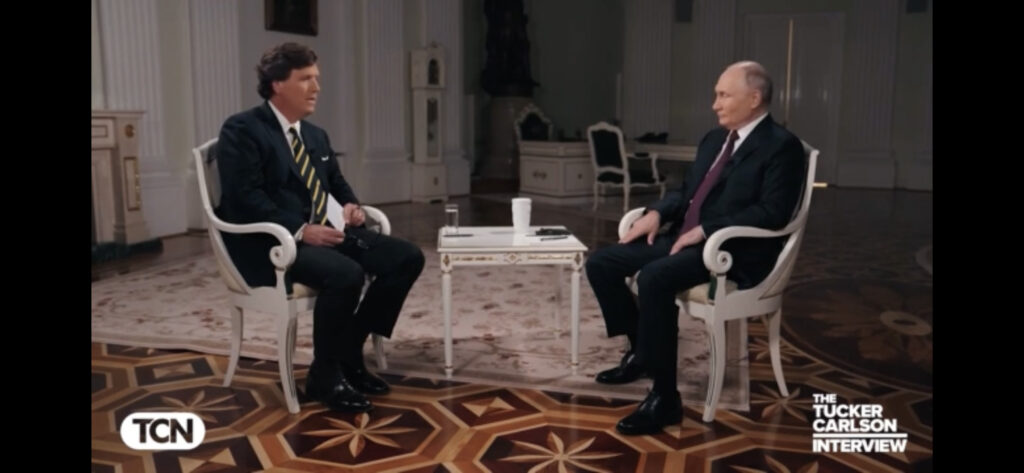
The discourse surrounding Tucker Carlson’s interview with Vladimir Putin has taken a contentious turn. While some may argue that hearing both sides of a story is crucial for a well-rounded understanding, reactions from the left have been mixed, with accusations of bias and conspiracy theories.
For days leading up to the interview’s release, Carlson faced criticism from the left, being labeled a liar and a right-wing conspiracy theorist. Former Secretary of State Hillary Clinton went as far as to dub him a “useful idiot.” Despite these strong words, one cannot help but notice a reluctance to engage with the content of the interview itself.
This begs the question: Why the apprehension to allow Putin to speak, and why the reluctance to hear both sides of the story? Could peace not come from open debate?
One potential explanation is the fear of misinformation or manipulation. In a highly polarized media landscape, concerns about biased reporting and the spread of falsehoods are not uncommon. It is crucial for consumers of news to approach any interview or news piece with a critical mindset, regardless of political leanings.
However, the reluctance to engage with opposing viewpoints raises concerns about the state of open discourse and the willingness to entertain different perspectives. Carlson traversed much aggression to get this interview with Putin. Ukrainian Organizations went as far as putting him on a kill list. This being done merely weeks after Ukraine reportedly killed US Journalist Gonzalo Lira in prison. Dismissing the interview outright without considering its content raises questions about the commitment to democratic ideals, including the freedom of speech and the exchange of ideas.
In a time where information is abundant but trust in media is often strained, it is more important than ever for individuals to critically assess the content they encounter. It is equally essential for media outlets and public figures to foster an environment where diverse perspectives can be explored and debated without resorting to attacks.
Regardless of one’s political inclinations, the release of Tucker Carlson’s interview with Vladimir Putin encourages a thoughtful examination of the arguments presented rather than a knee-jerk reaction based on preconceived notions. In a democracy, the free exchange of ideas is fundamental, and engaging with differing viewpoints is a crucial step towards a more informed and resilient society.
